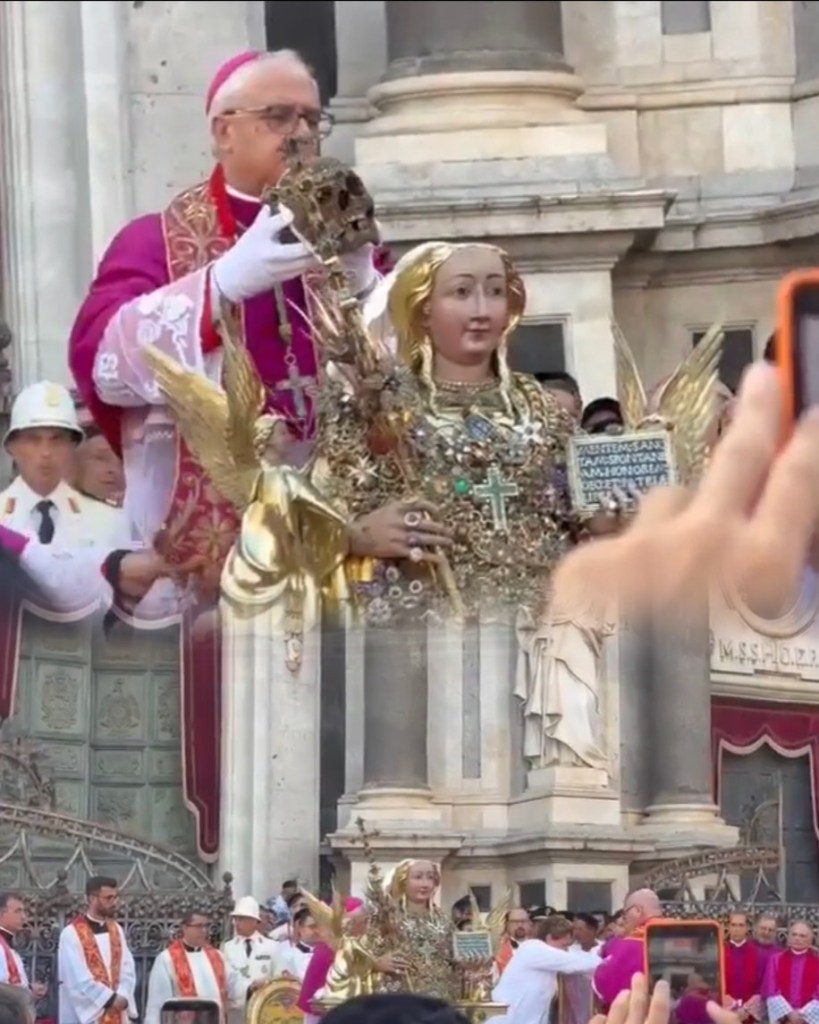
On the evening of 20 July 2026, the faithful gathered in the Cathedral Basilica of Catania to witness the 900th Anniversary of the Translation of the Relics of St. Agatha (1126–2026). Something that, to many outside the Catholic and Orthodox traditions, will seem strange, a crowd assembling to venerate a human skull. The newly restored fourteenth-century reliquary bust of St. Agatha, a gilded silver masterpiece commissioned in 1376, housing the martyr’s sacred skull, was unveiled alongside her veil, both painstakingly restored by the Vatican Museums’ conservation laboratories. The relic of the skull was even temporarily removed from its bust and placed in a separate reliquary so the faithful could venerate it directly. This year, Catania marks the ninth centenary of the return of Agatha’s relics from Constantinople (present day Turkey) in 1126, a celebration so significant that Pope Leo XIV appointed Cardinal Pietro Parolin as his Papal Legate for the August festivities.
Today, many clergy and laity, Catholic and non-Catholic alike are asking the natural question: why? Why does the Church, which teaches the transcendence of God and warns constantly against idolatry, gather crowds around bones and cloth? Is this not superstition dressed in liturgical vestments? These are fair and important questions, and they deserve a fair and reasoned answer, not a dismissal, and not mere sentiment. The Church herself insists that faith and reason are not enemies, and a practice this old, this widespread, and this theologically defended deserves to be examined honestly rather than reflexively rejected or reflexively accepted.
From the perspective of the Scriptures, relic veneration is not a medieval invention improvised by superstitious peasants, but its roots run through Scripture itself. In the Old Testament, when a dead man’s body was hastily thrown into the tomb of the prophet Elisha, “as soon as the man touched the bones of Elisha, he revived and stood on his feet” (2 Kings 13:21). Centuries later, the Acts of the Apostles records that “God did extraordinary miracles by the hands of Paul, so that handkerchiefs and aprons that had touched his skin were carried to the sick, and their diseases left them” (Acts 19:11–12). Even earlier still, the Gospels tell of a woman healed simply by touching the hem of Christ’s garment (Matthew 9:20–22), and of the sick being laid in the street so that Peter’s shadow might fall on them (Acts 5:15). These are not isolated curiosities. They establish a consistent biblical pattern: God does not despise matter as a vehicle of grace. He works through physical contact with holy people, their bodies, their clothing, even their shadow, because human beings are not disembodied souls but body-and-soul unities, and God meets us as we are.
The Catechism situates this practice within a much larger theological framework: the Communion of Saints. Because the Church “awaits the glorious resurrection of the body” and holds that “the body participates in the honor due to the person” (cf. CCC 990, 1004), the mortal remains of those who lived in heroic holiness are not mere biological waste. They are, in the Church’s understanding, the remains of temples of the Holy Spirit (cf. 1 Corinthians 6:19), destined themselves for resurrection glory. This is why the Council of Trent, addressing the very objections raised by the Reformers, taught in its twenty-fifth session that “the holy bodies of holy martyrs and of others now living with Christ… are to be venerated by the faithful,” because through them God bestows many benefits on humanity. Crucially, Trent did not teach that relics are worshipped. Sacred Tradition has always maintained a careful distinction, refined especially by St. Thomas Aquinas that the honor given to relics is not latria, the adoration owed to God alone, but a relative veneration, one that passes through the physical object to the person it represents. Aquinas argued that it is natural and fitting to cherish what remains of those we love, and more so the remains of those who were, in life, instruments of the Holy Spirit’s work. The Catechism applies the identical logic to images that it applies, by extension, to relics: “the honor rendered to an image passes to its prototype… whoever venerates an image venerates the person portrayed in it” (CCC 2132). The object is not the terminus of devotion. It is a doorway. This is also why altars themselves, per longstanding liturgical law reflected in the Church’s tradition, are customarily built to contain the relics of saints (CCC 1183), a physical reminder, every time Mass is offered, that the sacrifice of the altar is united to the sacrifice of the martyrs who “have washed their robes and made them white in the blood of the Lamb” (Revelation 7:14).
To the questions of not Superstition, but Incarnation, the deeper argument here is theological, not merely historical. Christianity is not a Gnostic religion that despises the body and prizes only the “spiritual.” It is a radically incarnational faith: the Word became flesh (John 1:14). God did not save humanity by rescuing souls from bodies but by taking a body Himself, dying in that body, and rising in that body, and He has promised the same resurrection to those who are His. A religion that believes the body will rise in glory has excellent reason to treat the bodies of its saints with reverence even now. To venerate Agatha’s skull is not to worship bone; it is to honor, in a tangible and human way, a woman who chose torture and death rather than renounce Christ, and whose body, the very instrument of that fidelity, the Church believes will one day share in her glory.
Someone may still ask, could this not become superstition in practice, even if the theology is sound? Yes, and the Church has always guarded against exactly that. Trent itself legislated against “all superstition… and filthy lucre” in the veneration of relics, and required episcopal oversight of authenticity precisely because the faithful’s devotion can, unchecked, curdle into magical thinking. That the Church built these safeguards into her own doctrine is evidence that she takes the objection seriously, she is not asking believers to suspend their critical judgment, but to exercise it rightly, distinguishing sound veneration (which honors the saint and, through the saint, God) from the superstition it can be corrupted into if divorced from that theology.
And to the reason Catania still gathers, 900 Years later, it is more than a civic pageantry. As the President of the Governorate of Vatican City State said at the July presentation, Agatha “is not merely its Patron Saint; she is its Mother, its faithful Guardian, its Protectress.” Nine hundred years of continuous devotion to one young woman’s relics testifies to something Scripture itself calls the Church to remember: that we are “surrounded by so great a cloud of witnesses” (Hebrews 12:1), not as a metaphor, but as a communion that spans centuries, uniting the pilgrim Church on earth to those who have gone before, marked with the sign of faith.
Finally, those who ask why the Church venerates relics are not wrong to ask. They are doing exactly what faith invites: seeking understanding. And the Church’s answer, drawn from Scripture, from the Fathers, from an Ecumenical Council, and from the Catechism, is neither embarrassed nor evasive. It is this: matter matters, the body will rise, and the saints, even in their bones, still preach Christ to those willing to look past the reliquary and see whom it honors.
Friar Emmanuel Idakwo OFM Cap.